How to Read Chinese at Your HSK Level with Dot Languages
Dot Languages has 12,000+ graded articles and dialogues for HSK 1–9, with pinyin, translation, and native audio for every sentence. See how reading works.
Last updated: November 23, 2026
Reading Chinese at your level is one of the fastest ways to build vocabulary and internalize grammar. Dot Languages gives you a library of 12,000+ articles and dialogues sorted by HSK and TOCFL level, with pinyin, a translation, and native audio attached to every sentence, and a tap on any word for its dictionary entry. Here is how reading works in Dot and how to pick material that matches your level.
How reading works in Dot Languages
12,000+ ready-made articles and dialogues, graded HSK 1–9 under the revised HSK 3.0 (2025) classification, with full TOCFL 2.0 (2023) support for Traditional-character learners
Pinyin, translation, grammar and native audio for every sentence
Tap any word for its dictionary entry; full word and grammar dictionaries built in
Basic plan is free and includes 3,000 articles, dictionary lookup, and basic exercises. Standard ($9.99/month or $6.99/month billed annually, as of November 2026) unlocks all 12,000+ lessons. Premium ($19.99/month or $12.99/month billed annually, as of November 2026) adds speaking, grammar, sentence, and character-writing exercises (see plans)
Chinese reading app with pinyin and audio for every sentence
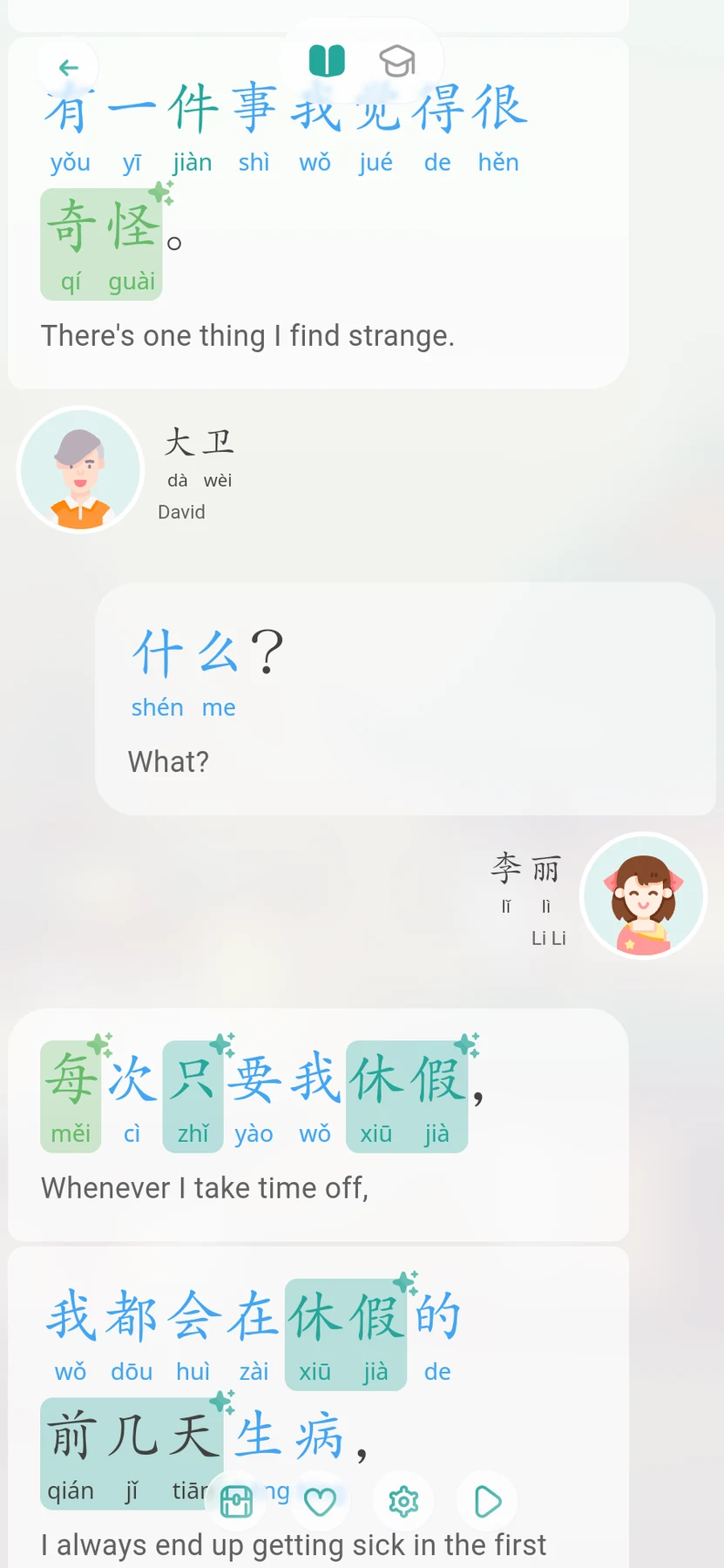
Every article and dialogue in Dot shows each sentence with three layers of support: the Chinese text, its pinyin, and a native-audio recording you can play at normal or adjustable speed. The translation sits alongside. You do not toggle these on or hunt for them; they are attached to every sentence by default.
Tap any word in a sentence and its dictionary entry opens, right in the reading view. Because the full word and grammar dictionaries are built in, you do not leave the reading view to look something up.
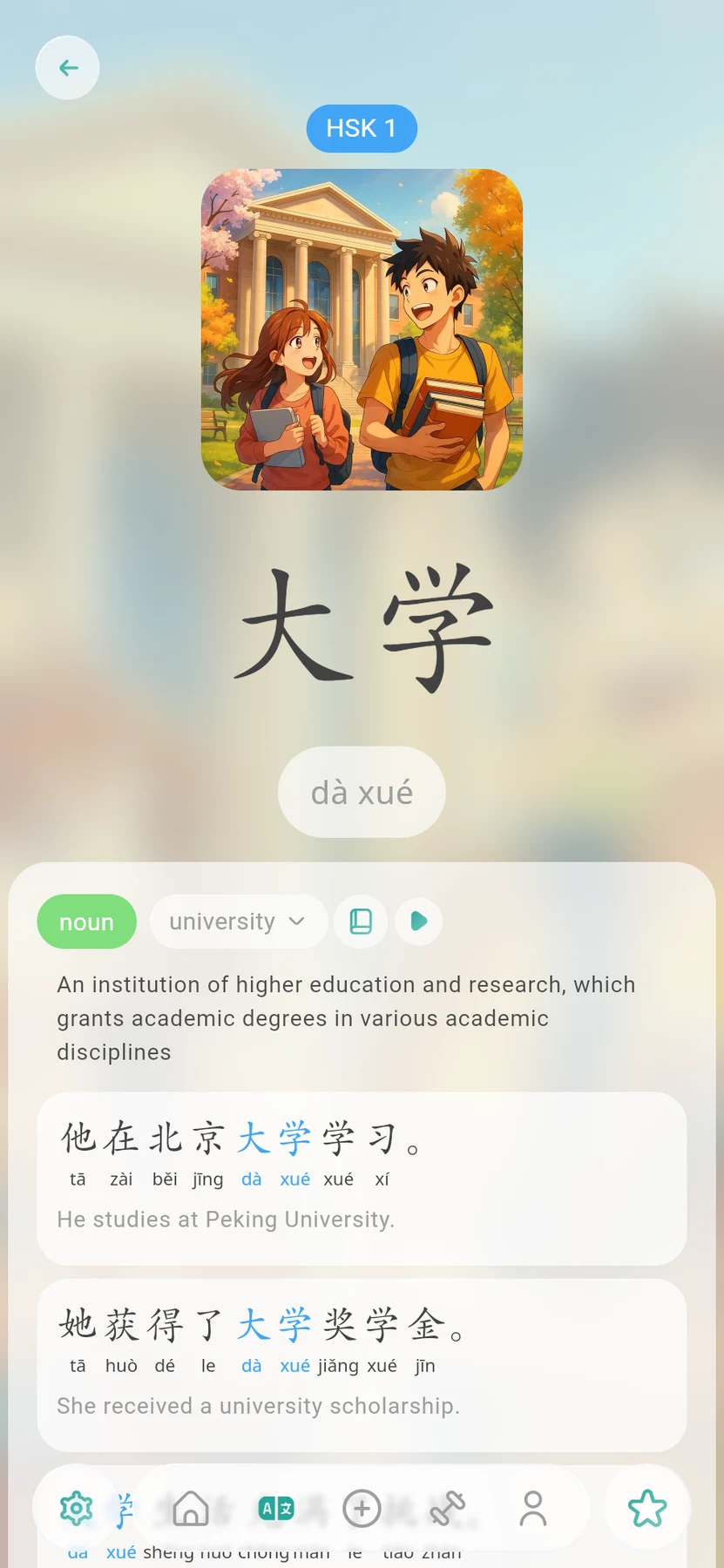
This matters for reading practice because the friction is low. When you hit an unknown word, you tap, read the entry, hear the sentence again if you want, and keep going. You stay in the text instead of switching to a separate dictionary app.
App with Chinese articles sorted by HSK level
Dot's library is graded across HSK 1–9 under the revised HSK 3.0 (2025) classification, with a selectable TOCFL 2.0 (2023) system covering all levels for Traditional-character learners. If you have not migrated to the newest HSK version yet, Dot also supports HSK 3.0 (2021).
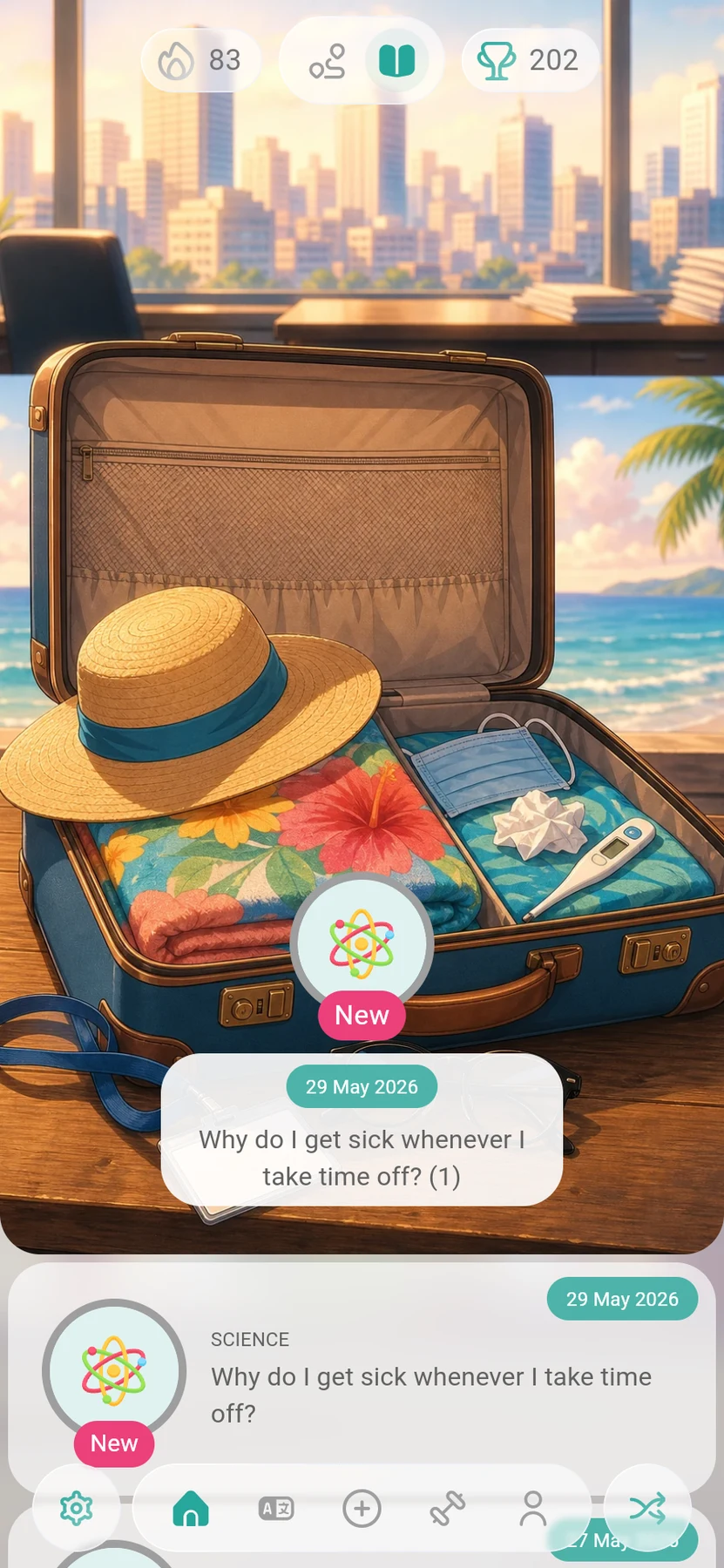
You browse articles and dialogues by level, pick one that fits, and read. The library holds 12,000+ lessons as of November 2026, with new ones added daily, so you are not re-reading the same ten stories. The Basic plan is free and includes 3,000 articles, dictionary lookup, and progress tracking, so you can start reading at your level without paying. Standard unlocks the full library and lets you decide your own study order and focus.
To support learners from absolute beginner to advanced proficiency, Dot splits reading material into two distinct, complementary formats: conversational dialogues and connected prose articles.
Conversational dialogues for early and spoken Mandarin
Dialogues present practical exchanges through speaker-labelled conversation bubbles. They show you how native speakers ask questions, give natural responses, and use daily expressions. This format is ideal for lower levels, such as HSK 1 or HSK 2, where mastering short conversational exchanges provides an immediate boost to your speaking and listening confidence.
Here is an example of an early-level conversational exchange:
Seeing spoken phrases organized by turn makes it simple to follow who is speaking, mimic tone and rhythm with sentence audio, and internalize spoken syntax before tackling dense text blocks.
Connected articles for reading fluency and expanding vocabulary
Articles present continuous prose in a traditional reading view. They are designed to help you follow explanations, narratives, and discussions across longer paragraphs. Articles suit intermediate and higher tiers, such as HSK 3 and above, introducing topics like cultural traditions, current news, technology, and lifestyle.
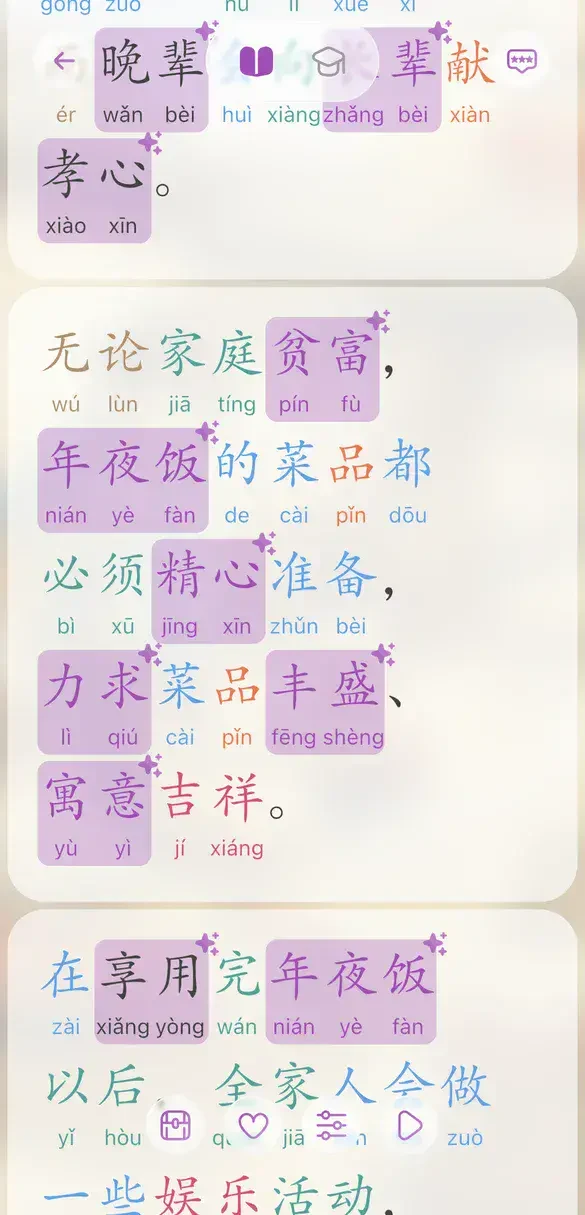
Here is an example sentence from a higher-level prose article discussing cultural customs:
Reading connected prose trains your eyes to parse complete clauses and follow discourse markers across multiple paragraphs. Because both dialogues and articles include instant dictionary definitions, adjustable audio, and sentence translations, you can shift between conversational dialogue and formal reading as your proficiency develops.
Chinese graded reader app pinyin audio every sentence
"Every sentence" is the part learners ask about, and in Dot it means exactly that. There is no article where the audio stops after the first paragraph or the pinyin is missing from harder lines. Each sentence in each article and dialogue carries its own pinyin line, translation, and native recording.
The native audio plays at adjustable speed, so you can listen at a slower pace while you are learning a passage, then at natural speed once you know it. Listening while you read ties the characters to the sounds, which builds reading fluency and listening comprehension together.
How Dot compares for graded reading
The graded-reading space has several strong apps, and they differ in what they offer and how they are priced. Here is where Dot fits, using current details as of November 2026.
App | What you read | Levels | Price (US, as of November 2026) |
|---|---|---|---|
Dot Languages | 12,000+ articles, dialogues, video lessons | HSK 1–9 (3.0, 2025); TOCFL 2.0; HSK 3.0 (2021) | Basic free (3,000 articles); Standard $9.99/mo; Premium $19.99/mo (as of November 2026) |
Du Chinese | Graded stories, articles, courses | Own six levels, ~HSK 1–6 | Some free lessons; $14.99/mo, $79.99/6mo, $119.99/yr (as of November 2026) |
The Chairman's Bao | Graded news | HSK 1–6+ (version unstated) | $11/mo, $88/yr, $450 lifetime (as of November 2026) |
HSKStory | Graded stories | HSK 1–9 (2025 list) | 3 stories free; $9.99/mo, $84/yr, $199 lifetime (as of November 2026) |
Dot Languages is a strong choice if you want a large graded library that runs all the way to HSK 9, works in both Simplified and Traditional, and pairs reading with dictionaries and word, grammar, and sentence exercises on the same platform. The free Basic plan covers 3,000 articles with no paywall and no ads, so you can read at your level without subscribing.
Du Chinese has a large story library with native audio and is well regarded for reading volume, but its levels top out around the old HSK 6 and do not follow HSK or TOCFL officially. The Chairman's Bao is the pick if you want news rewritten by level. HSKStory grades to the 2025 HSK list and is good for short stories. Dot's advantage is range and integration: HSK 1–9 and TOCFL, both scripts, 12,000+ lessons, and dictionaries plus exercises built into the same app.
Get started reading in Dot
Dot Languages runs on iOS, Android, Web, macOS, and Windows. Download the app, pick your level (HSK 1–9 or TOCFL), and open any article. The Basic plan is free. If you want the full library and control over study order, Standard is $9.99/month or $6.99/month billed annually as of November 2026. Premium adds speaking, grammar, sentence, and character-writing exercises at $19.99/month or $12.99/month billed annually as of November 2026.
App Store Google Play Microsoft Store Download for macOS Open web app
Frequently asked questions
Is there a Chinese reading app with pinyin and audio for every sentence?
Yes. Dot Languages attaches pinyin, an English translation, and native audio to every sentence in its articles and dialogues, and a tap on any word opens its dictionary entry. Du Chinese and The Chairman's Bao also provide audio and tap-to-translate on their lessons, and HSKStory offers narration and optional pinyin on its stories.
Which app has Chinese articles sorted by HSK level?
Dot Languages sorts 12,000+ articles and dialogues by HSK 1–9 under the revised HSK 3.0 (2025) classification, with TOCFL 2.0 support for Traditional characters and HSK 3.0 (2021) for users not yet migrated. Du Chinese uses its own six levels rather than official HSK, The Chairman's Bao grades HSK 1–6 without stating the syllabus version, and HSKStory grades stories to the 2025 HSK 3.0 list.
Is Dot Languages good for reading at HSK 3?
Yes. At HSK 3 you can read Dot's HSK 3 articles and dialogues with pinyin, translation, and native audio on every sentence, and tap any word for its entry. The free Basic plan includes 3,000 articles, so you can read at HSK 3 without paying. Dot also supports HSK 3.0 (2021) and the 2025 revision, so it matches whichever version you are studying. The limit at HSK 3 is that the free Basic plan holds back the full 12,000+ lesson library and the Premium exercise types, so heavy readers or those wanting speaking and writing drills would look at Standard or Premium.
What is the best Chinese graded reader app in 2026?
It depends on what you want. Dot Languages suits learners who want a large library graded HSK 1–9 with pinyin, translation, native audio, and built-in dictionaries and exercises, with a free Basic plan. Du Chinese is strong for reading volume in stories, The Chairman's Bao for graded news, and HSKStory for short stories tied to the 2025 list. Prices and features as of November 2026 are in the comparison table above.